



A. General Information
UK Ecosystem of Trust (EoT)
- HM Revenue and Customs (HMRC)
- Department for Environment, Food and Rural Affairs (Defra)
- Home Office / Border Force
- Food Standards Agency (FSA)
- Animal and Plant Health Agency (APHA)
1. Azarc
2. Chainvine
3. IBM & Maersk (with Hutchison Ports Port of Felixstowe, Maritime Cargo Processing, Pure Electric, Quantexa, Westbridge Foods, WM Morrison Supermarkets)
4. Fujitsu
5. Palantir (Connected Borders)
6. Institute of Export & International Trade (IOE&IT) with IOTA Foundation, Supply Chain Tracking (SCT) Technology, Maritime Cargo Processing, Retail & Asset Solutions
- HMRC
- Defra
- Border Force
- Port operators (Felixstowe, Dover, Harwich, London Gateway, Liverpool, Immingham, Southampton)
- KenTrade (Kenya Single Window)
- TradeMark East Africa
B. Lessons Learned
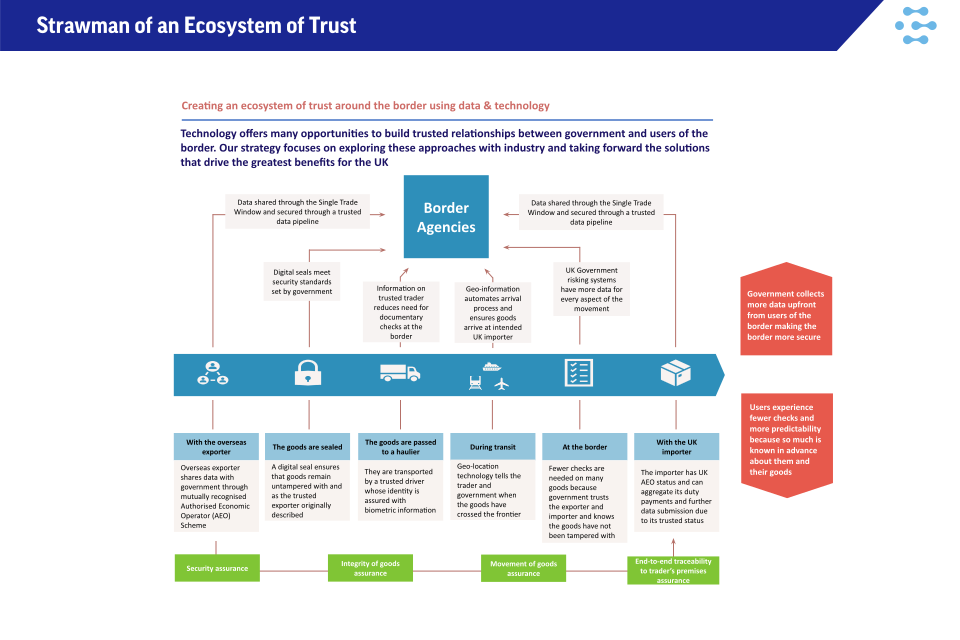
The UK Ecosystem of Trust (EoT) pilot tested whether innovative technology, real-time supply chain data, and trusted trader relationships could provide government with new ways to assure goods crossing borders, enabling frictionless trade while maintaining security and biosecurity.
To test whether a new border model using supply chain data, augmenting technologies (smart seals, GPS tracking), and trusted relationships could reduce trade frictions without compromising UK security or biosecurity. The goal was to create frictionless import/export experience for compliant trusted traders while focusing enforcement on higher-risk traders.
Post-Brexit, UK needed to redesign border operations. Current processes are transactional, creating administrative burdens for traders who submit similar information to multiple government entities. Physical checks add costs and delays. The 2025 UK Border Strategy set out the vision to use data and technology to create the most effective border in the world.
- Pre-arrival supply chain data sharing
- Customs declarations and risking
- Sanitary and Phytosanitary (SPS) controls
- Safety and security targeting
- Goods integrity assurance via smart seals/containers
- Cold chain monitoring
- Trade document digitization
Each consortium deployed a supply chain data platform (system of record) with dashboards providing views for government and industry. Data was shared via dashboards (for visual inspection) and structured file exports (CSV, XML, JSON). Technologies included: smart seals with GPS/tamper detection, smart containers with environmental sensors, electronic labels with QR codes, and distributed ledger technology for data immutability.
- Commercial invoices
- Packing lists
- Bills of lading / Airway bills
- Export Health Certificates (EHCs)
- Phytosanitary certificates
- Certificates of origin
- Customs declarations (import/export)
- CMR transport notes
- Transit documents
- Catch certificates
- Movement Reference Numbers (MRNs)
- Journey tracking data
- Smart seal telemetry data
- Temperature/humidity readings
- Approximately 28 new data elements made available to Border Force targeting teams
Hybrid approach using proprietary consortium platforms (Azarc Rune, Chainvine BlueRing, Palantir Digital Goods Passport, TLIP, Fujitsu Atamai Freight, TradeLens) integrated with UK government systems via dashboards and file transfers. Some used distributed ledger technology (blockchain) for data immutability.
- Interoperability: Biggest barrier; integrating industry data into government systems at scale proved challenging
- Data format issues: Much data was unstructured (PDFs) rather than machine-readable
- Data standardization: Values provided in wrong formats (USD vs GBP, mm/dd/yy vs dd/mm/yy, grams vs kilograms)
- Missing data fields: Some government-required data elements not typically in commercial documents
- Data governance: Complex data sharing agreements needed
- Technology circumvention: Smart seals can be bypassed by determined criminals
- Limited time: Government systems not integrated during pilots due to resource constraints
- Industry can provide higher quality, timelier data than currently available through declarations
- Supply chain data can provide 80% of minimum customs risking requirements and 60% of trade statistics requirements
- Decision-making time could potentially decrease by 17%
- Interoperability is the biggest problem to solve
- Government must define clear facilitations/benefits to incentivize industry participation
- Collaboration between government and industry is essential for driving innovation
- "Signals" approach (exception-based notifications) more efficient than continuous data streams
- Electronic Trade Documents Act passage critical for enabling digital trade documents
- International interoperability with trade partners is key
- UK Government backed £180 million commitment for establishing Single Trade Window
- Over £1 billion investment across spending review period for border transformation
- Industry consortia participated at their own cost in exchange for opportunity to shape future border
- Findings will inform UK Single Trade Window development (delivery from 2023, fully operational by 2027)
- Defra Trusted Trader scheme pilots for SPS goods launched September 2023
- HMRC streamlining Customs Trusted Trader Schemes authorisation processes (2024-2025)
- Border Trade Demonstrator (BTD) initiatives to continue testing
- Development of open-source "toolkit" to lower barriers to EoT participation
- Maersk in dialogue with UK Government and other countries about extending trusted trade lanes
- Project aligns with 2025 UK Border Strategy vision
- Electronic Trade Documents Act 2023 places digital trade documents on same legal footing as paper
- Similar initiatives underway in EU (customs overhaul by 2032) and US (next-generation single window)
- IOE&IT paper estimated EoT could reduce border delays by 80% and add 1% (~£25bn) to UK GDP
C. Relevant Standards
- Electronic Trade Documents Act 2023
- Border Target Operating Model
- WCO SAFE Framework of Standards
- Common Transit Convention (CTC)
- Structured file exports (CSV, XML, JSON) for batch processing
- No full technical integration with government systems during pilots due to time/resource constraints
- HMRC received data via dashboard viewing and file upload
- Integration planned via UK Single Trade Window
- Smart seals (GPS enabled, tamper detection, remote unlocking)
- Smart containers (temperature, humidity, atmosphere monitoring)
- Electronic seals (radio frequency, scan-based tracking)
- Electronic labels (QR codes linking to product data)
- Intrusion detection sensors (CO2, light, speed monitoring)
- Fleet management/geolocation tracking
Platforms Used:
- Azarc: Rune Utility Trade Network
- Chainvine: BlueRing dashboard with Octosense smart seals
- Palantir: Digital Goods Passport Platform (Connected Borders)
- DBM-ATC: Trade Logistics Information Pipeline (TLIP) with SecureTrak seals
- Fujitsu: Atamai Freight platform with smart seal technology
- IBM-Maersk: TradeLens (blockchain), Remote Container Management, Quantexa for risking
Last Update: 28 November 2025