



A. General Information
Thailand e-Form D - Electronic Certificate of Origin under ASEAN Trade in Goods Agreement (ATIGA)
- Thai Customs Department, Ministry of Finance (for Thailand NSW)
- ASEAN Secretariat (for ASEAN Single Window)
- USAID ASEAN Connectivity through Trade and Investment (US-ACTI) program
- Thai Customs Department, Ministry of Finance
- Customs administrations of ASEAN Member States
B. Lessons Learned
Thailand's e-Form D enables Thai exporters to electronically apply for and receive ATIGA Certificates of Origin through the DFT Smart C/O system, with automatic transmission to destination countries via the Thailand National Single Window and ASEAN Single Window.
To replace paper-based certificate of origin issuance with fully electronic processing, expedite customs clearance in destination ASEAN countries, eliminate need for physical documents, reduce costs for Thai exporters, and support ASEAN economic integration through paperless regional trading.
Previously, Thai exporters had to apply for paper-based Form D certificates to claim preferential tariff treatment under ATIGA. This created delays, required physical document handling, and increased costs. The shift to electronic processing addresses these inefficiencies and supports ASEAN's trade facilitation goals aligned with WTO TFA commitments.
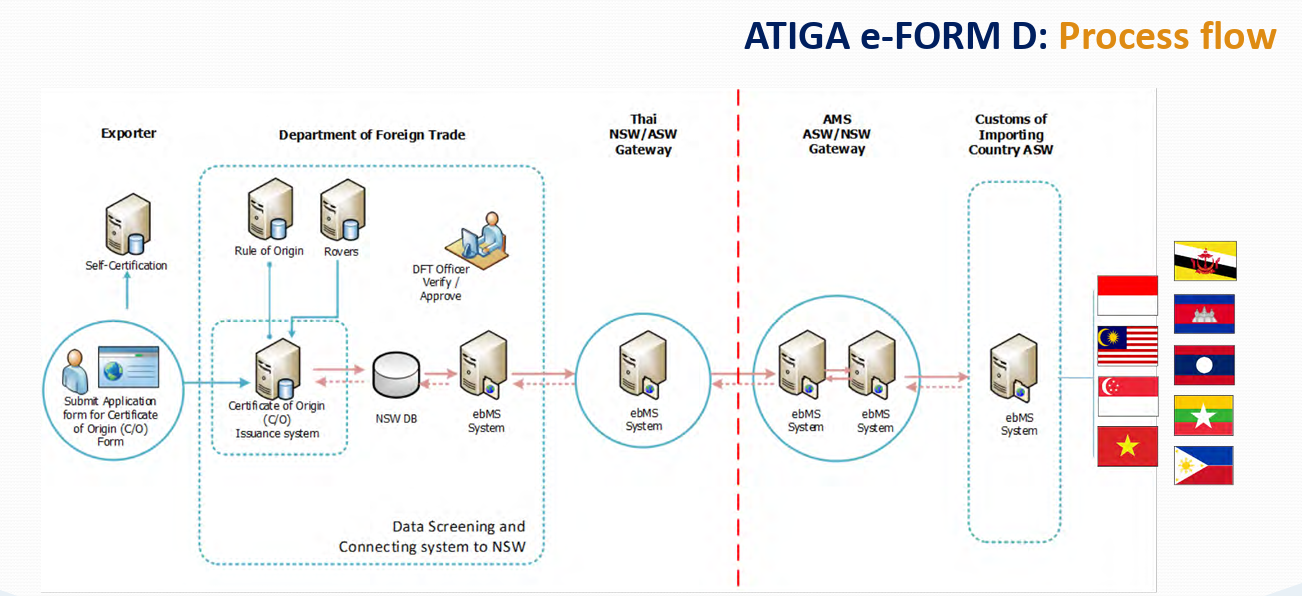
Electronic application for Certificate of Origin (Form D) by exporters, electronic issuance by DFT, electronic transmission via Thailand NSW to ASEAN Single Window, receipt by destination country customs for granting preferential tariff treatment.
Thai exporters register and apply for e-Form D through the DFT Smart C/O system. Upon approval, the electronic certificate is transmitted through Thailand National Single Window (NSW) to the ASEAN Single Window (ASW) gateway. The ASW securely routes the e-Form D to the destination country's NSW and customs administration. Destination customs can then grant preferential tariff treatment based on the electronically received certificate without requiring paper documentation.
- ATIGA e-Form D (Electronic Certificate of Origin)
- Exporter registration data
- Product origin verification data
- Tariff preference claim information
Thailand NSW uses ebXML standard for electronic messaging and Public Key Infrastructure (PKI) with digital signatures for secure electronic document exchange in the single window environment.
Initial technical issues during live operation due to complexity of integrating distributed NSW systems across multiple ASEAN member states; ensuring all 10 ASEAN members achieved technical readiness; addressing exporter registration requirements; coordinating between customs and certificate issuing agencies across borders.
Proactive and intensive communication among traders and respective administrations (Customs and Certificate Issuing Agencies) should be strengthened. Bilateral coordination is essential to resolve technical issues. Gradual phased implementation (starting with 5 exchange-ready states before expanding to all 10) proved effective.
USAID assisted ASEAN Single Window implementation and expansion through its ASEAN Connectivity through Trade and Investment (US-ACTI) program.
ASEAN plans to expand ASW to include additional documents such as ASEAN Customs Declaration Document (ACDD), electronic Phytosanitary Certificate (e-Phyto), and electronic Sanitary Certificate. ASEAN is also developing roadmap for exchange of e-documents with ASEAN Dialogue Partners beyond the region.
As of 1 January 2024, all 10 ASEAN Member States have implemented full transmission of electronic Form D, and importing customs administrations may reject hardcopy Form D presented for preferential tariff claims. Exporters can still opt to print hard copies by purchasing certificate paper from DFT, but electronic processing is encouraged.
C. Relevant Standards
- Agreement to Establish and Implement the ASEAN Single Window (2005)
- Protocol on the Legal Framework to Implement the ASEAN Single Window (15 September 2015)
- WTO Trade Facilitation Agreement (TFA) - Article 10.4 on Single Window
- Thailand Electronic Transactions Act (ETA)
Last Update: 2 December 2025